Showing posts with label China. Show all posts

Saturday, 17 November 2012

British public schools exported to China

The BBC's George Alagiah reports on the rise of fee-paying schools in China which mirror British public schools.The schools are in contrast to the state system in China, with an emphasis on creativity and inquiry.


Amidst the growth of the glass and concrete grown of the city of Tianjin is Wellington College, a replica of the Berkshire school, there are 300 students mainly from the ex-patriate community but with a growing number of Chinese students. Mimi Zhoh is only 5 years old but her prestigious piano playing talent, has already seen her perform at the Royal Albert Hall in London. Mimi's parents pay more than £15000 a year in fees, they are doing more than buying an education,they are investing in a way of life. Her parents do not want her to endure the 24-7 life in China and in the future, want her to study abroad.

In light of the new visa restrictions for Chinese students coming to the UK,  David Cook, Master of Wellington College,in Tianjin, believes Chinese government should make it easier as possible for Chinese students to come to study in Britain, because the alternative means they are almost inevitable to go America to study.


Watch here: http://www.bbc.co.uk/news/world-asia-20259954

Monday, 12 November 2012

Can BBC's Find Happiness In The Far East?


With the endless western media Sinophobia, enforced 'invisibility' of our British community, for BBCs who haven't completely embraced multiculturalism, being a 'minority', increasingly depressing economic times, even if you are relatively quite well off financially, if you have an ounce of social observation/sympathy, it can at times be difficult to 'switch off' from negative news around us.

In the East however, things are looking better comparatively, BBC's whose parents are from the New Territories often have village homes they can travel to and from, relatives they can stay with for some time, whilst looking for work, or even just for a break from being here in the UK. 

Culturally, for some BBCs although popular HK/Chinese music TV or Film may not compete in quality with western output, China is increasingly becoming westernised, and in both China and Hong Kong there are many English speaking students, not to mention many who want to learn the English language.

The main problem for some BBC's is the Chinese language, having already integrated with western society or encouraged to continue to speak Cantonese/Mandarin growing up, as well as we ought to,  though it may take some time to get back to a fluent level, if we are lucky to have helpful parents, and sometimes friends/relatives or spouses who do,we can have an advantage when it comes to improving our speaking ability which can obviously help us when it comes to finding work out there.

In the UK, It's clear western media will not tolerate Chinese,except at arm's length, BBC's will never create an independent media, FOBS will continue to run their FOB businesses and create their own exclusive FOB-only circles, all of which will do nothing for British Chinese social identity despite China's growing world presence.

Despite partnering with British Companies, until China buys up western media, which could be some time off, if ever, and British Chinese community takes more social interest beyond 'Self-interest', for BBC's who want to reconnect with our Chinese heritage, looking to the Far East as a serious option for relocation, if not a long extended stay, could be the missing piece in our culture-starved lives.


As an ethnic Chinese living in Britain,  how do you feel, about the fact you and future generations growing up in the UK may never be fully accepted by British society, and only tolerated? And if relocating to the Far East, is an option by contrast, is it one worth considering?

Wednesday, 17 October 2012

China’s Success Creates Further Racism For BBC's and China Nationals Living In The West


In Britain, there is no question that ethnic minorities are slowly finding their voices. Afro Caribbean Black people, African Black people, Indians and Pakistanis form sizable groups, all quite well established and more importantly proud of their individual status and also part of an ethnic group with its own culture.

Amidst all this, ethnic Chinese seem to form fragmented communities punctuated by Chinese supermarkets dotted around large cities where once a week or month, Chinese people may come together to do their shopping specific to their personal needs.

Dig deeper and it’s very evident that many younger Chinese are no longer going to these places to shop and more and more have merged into the host nation’s culture. This is natural of course, after all, we are all living in Britain and will form friendship with people indigenous to this country.

Please see below an article about our history, a study done in London 2009 to help find out the changing needs of the Chinese community within London. I’m sure many can recognise and relate to the findings:


Many cultures that have formed in Britain, the ethnic minorities that have grown strong in political power and religion tend to all have been part of the British empire. Yet China, no stranger to foreigners pillaging its treasures can still argue it had never officially been colonised. It’s this one single fact that I believe determines our struggle to gain acceptance and even respect.

The simple matter is many Chinese nationals enter this country quickly work their way up the social ladder through education or hard work. You compare this with other ethnic groups, and will quickly see that we can work our way up the ranks in job titles or in earning power. This is mimicked across all western developed countries too. A study in June 2012 conducted in America showed precisely how Asian Americans rose quickly up the ranks in a short space of time compared to other ethnic immigrants.


Based on these statistics alone, you would think that we would have more say and  respect, and yet Black Africans and Pakistanis can command more rights and respect which tells me two things. You need to be a victim (colonized before) or you need to show struggle to get something in life. The British love a sorry case. Both not really linked to the Chinese communities here in Britain.

Whilst we are busy integrating, China has been growing stronger. Many BBC's will have watched from far mostly disinterested in what’s happening. But unknown to many BBC's, the media in the meantime have been building a slow hate campaign against China. Only able to get away with it because of the sheer fact that the ‘challenger’ had never been colonized. The brazen press go into over-drive very often with little evidence, claiming China’s closed society as the reason for the sketchy research and potential lies.

China might be emerging and about to take on America. BBC's growing up here do not seem to form any kind of link or opinion on China. Probably thanks to our parents’ ignorant views on Mainlanders formed from decades before. I find it strange that many either are ignorant or ‘choose’ to not link or discuss things relating to China. Even this blog sometimes can be accused of failing to discuss China, which is very narrow minded since we all have a history, and it pays to understand the whys and where because in the end, to form a sub-culture or new culture, you need to have started from somewhere to get here.

Many BBC's fail to link this issue, and I believe failure to do this either comes from our upbringing because many of our parents are still riding this fake high believing it’s pre-1997 Hong Kong and being part of the empire makes them extra special. Many are ignorant towards China, almost distancing themselves, therefore creating this separation for us to believe to be true when half of the British population can’t tell China from Taiwan let alone Hong Kong. We are all Chinese to them…

Many minority groups in Britain are very interested in their history, whether vaguely or detailed. Many also have parents that have taught them to be very proud and stand up for their own rights as a minority. Chinese people living abroad tend to do the opposite. They tend to teach their kids to bury their heads and beaver away through education. I have even witnessed some telling their children to forget about their past.

What do we get in the end?  Someone who can perform in their jobs and earn a lot of money. But collectively, BBC's are possibly invisible, with no kind of culture or strong presence that speaks for the BBC's. Why? Because we have more or less adopted this country with our arms open. We do this because our parents did. We do not view this country with suspicion like other minority groups here do in Britain. The Empire thing helps to cement that suspicion. But for BBC's, we are led (falsely) to believe we are one of Britain’s specially protected regions. Simple fact is, hardly anyone knows the full difference of Hong Kong and China nowadays.

With our parents failing to teach us a full account of our own history. We blindly go about our days never asking the questions. Questions like: Why are we not looked upon with any kind of respect.  Why are we expected to take insults more readily and accept slurs at the drop of a hat.

The answer lies in China. It was never part of the empire and, now able to challenge the west on capitalism after years of manufacturing. The political powers and the media controllers are unable to contain themselves with the bitter jealousy. Even more annoying is the fact that China was not expected to rise in any shape or form, especially after communism.

BBC's in Britain can gain acceptance if they either merge themselves in British culture and clear themselves of any traces of Chinese heritage. Many BBC's are already more closely linked to British culture than Chinese culture. Quite a few play ignorant regarding anything to do with China. There are many that don’t want to discuss Falung Gong, Dalai Lama’s exile and the struggles of Uighurs’ independence etc, because they are deeply unpopular subjects for Britons rather than ourselves, possibly blurring our boundaries of BBC's and Mainland China.

My question is, by doing these things, it’s denial and turning down a chance to face head-on where we are in Britain. Why are so many highly educated staying silent on subjects that should be close to our hearts? Many ethnic minorities who are very passionate about their past, their heritage and yet, they are able to incorporate that in with their culture here in Britain. They then also enjoy the victim status awarded to them by the western nations, which Chinese nationals do not get because the Chinese are not victims but villains.

Why? Because we are not victims in the eyes of the west because we were never officially colonised. A problem for BBC's living in Britain today. Our voices are made even more weaker because we are actually viewed with suspicion.

A couple of cases proved this in America when ABC's were even accused of being spies when they were working for a computer chip company. Many of the allegations die down and you never hear from them again. Because they are unsubstantiated. Such headlines are now part of the norm because the media are normalising this image of untrustworthy Chinese people who cannot be trusted, even if they’re brought up in America. Chinese students that are highly educated are routinely accused of being spies for China if they so happen to make a tiny mistake for a computer company. If they hack, expect the police to be at their door within minutes.

Below are just some links and examples that are regularly littering the headlines and internet:

According to Sir James Dyson , ‘he thinks’ the Chinese come here to study for dubious reasons. To steal secrets for their own technology. These unchallenged claims are able to fill even the broad sheets, where one of Britain’s leading inventors  can openly accuse a whole nationality of such actions speaks volumes. Not only is it now some kind of an open secret, his claims are receiving nods from others too. He would certainly receive a reprimand very quickly if he had said Nigerians did that.


The Telegraph found time to tell us how the French intelligent service had warned how the pesky Chinese are partial to stealing information for company gain. Read the article carefully, and you soon recognise it’s an exercise to tell French companies to be more smarter since all techniques employed by the Chinese companies are perfectly within their rights. When the Chinese are smarter in business, they are spies apparently.


Finally, BBC’s highly in-depth report on ‘China’ sending thousands to developed countries to deliberately gather important data to help its development. They reluctantly accept that some are just rich families who want their children to do well, so choose to study abroad, but note, the general tone is Chinese only get to where they are because they are cheats and spies. China can’t get to where they are through merit, it has to be something sinister and nasty. More slanderous news reporting.


In the end, it means we as an ethnic group can be despised rather than admired. So for those that bury their heads, merging in with the host nation’s culture, thinking Britain will accept them, I think not. Not until the day China collapse, we will never have a sympathetic voice or able to draw government money to help with the Chinese communities because we are not one of Britain’s victims. Even more damaging, we may be witnessing a new-wave of racism directed at us, more intolerant and more blatant. All because of China’s ability to stand up without the hand-out and help of the west.

We as BBC's must admit this. Until we open our eyes and accept this, we will never have a fair voice. We need to rise up and fill the internet with pages of the media hatred and unjust reporting going on daily. We need to wake up from the comfortable surroundings and understand that if we believed in equality as the western education taught us, we need to look closer for equality.

If we don’t start now, in a decade’s time, we may be seeing full-on hatred. People from the streets, our colleagues and neighbours could one day turn against us, all because of our failure to speak up and say how we feel and utilise our knowledge of our rights and demand respect and fair reporting. It’s time for BBC's to fight back, show pride in ourselves and our ethnicity here and in China.


(By Guest Blogger- BBCNewAgenda is a British Born Chinese Female living in the UK)

Wednesday, 26 September 2012

Chinese Plastic Surgery


Being born in Britain, our parents wanted the best start in life for us. Indeed, many British Born Chinese excel beyond their parents’ expectations. Whilst British Born Chinese females get on with life, few feel a need to alter their looks to fit in with the western ideal of beauty. I know no-one that feels compelled to try out the outlets in South Korea or Hong Kong that perform the “double eye-lid” surgery, none that want to buy skin whitening cream, nor spend precious earned cash on calf reduction.

Opening a Chinese gossip magazine or seeing the hordes of fresh faced East Asian female students entering the UK, it’s apparent that many East Asians take their appearance very seriously, their skin is often lightened, their eyes widened, their eyelashes extended and their breasts don’t sit naturally on a slight frame - in many ways they look like a celebration of the western identikit.

In Britain, whilst many of our role models are white, British Born Chinese women do not feel a need to go under the knife to look white. FOBs on the other hand have been marketed to look up to white culture, its not uncommon for East Asian female stars to get by on their looks alone. The way the media markets beauty to East Asian women seems to be about the superficial things in life, especially in Hong Kong and China, this transforms into a copied culture often seen on the internet.

Statistics from The Asian Plastic Surgery Guide showed that in 2009, an estimated 74 out of 10,000 people from South Korea had gone under the knife. Typical Korean plastic surgery procedures include the classic double eyelid surgery (blepharoplasty) and jaw re-alignment surgery. Other popular procedures include shaving cheek-bones to create a more smoother silhouette and calf reduction. Surprisingly, breast enlargement was not among the top procedures. Many believe a core is made up of Chinese nationals favouring top rated surgeons in Korea. 


The running theme is altering our natural Asian looks and replacing them with western ideals of beauty. Magazines are filled with western products designed mainly for the western market, but are pushed in magazines for Oriental women and modelled by Caucasian or Asian white mixed Eurasian models. This is the norm.


I believe that for many East Asian women, the competitive nature that has been well documented with the pushy Tiger mother/father upbringing has led to many seeking much more than academic achievement. Those lacking in that department, should at the very least have a presentable and enviable physique. Insecurity occurs when there is no real pride in our natural form. Our parents are ashamed, so we might as well be too. If parents spend more time criticising instead of encouraging us, how can we feel comfortable in our own skin?

As a British Born Chinese female, criticising and belittling was part of my upbringing. Being tall and pale was a measure of success. This can often lead to rebellion, or caving in to seek what our parents expect of us. Further from that, imagine being self-conscious and then being fed the idea that western beauty is the pinnacle of beauty. Yet, despite that, on closer scrutiny, there is a silver lining, our parents have inadvertently created a more robust British Born Chinese ready to rebel against all this superficial nonsense.

Here in Britain, you are living at close quarters, seeing things with warts and all, it soon hits you, aspiring to look like a white person is delusional. Perhaps in China, society is more competitive, looking like a white person may get you a better job, but here in Britain, you can’t fool the people here. Looks are not the answer, aspiring to look white will not earn you respect.

(By Guest Blogger- BBCNewAgenda is a British Born Chinese Female living in the UK)

Friday, 21 September 2012

A Tale of Two Chinas Channel 4

A Tale of Two Chinas Channel 4 More4

Channel 4 documentary following Anglo-Chinese businesswoman Carrie Waley, who runs a school for Chinese students eager to learn British culture and etiquette and make it big in the UK, as she returns to her roots in China. 


Body language, eye contact, social kissing – all are a minefield for Chinese wannabe Westerners. And that is where Carrie Waley steps in. At 48, she doesn’t have the qualifications or stellar CVs that many of her protégés possess. But as someone who was born in Beijing and lived much of her adult life in the UK as the wife of an Eton- and Cambridge-educated barrister, she has found herself uniquely placed to bridge the East/West social and cultural divide.  

Carrie Waley is a Mandarin consultant. For fees of £500 upwards, she offers coaching to job-hungry candidates from China and, conversely, teaches British executives how to ingratiate themselves with leading players in the Chinese economy. ‘We all prefer our own customs, but we know that learning each other’s will help us to get ahead,’ she says. Well-spoken and immaculately groomed, Carrie is everything you would expect of a woman running an image-conscious business. Her company has grown rapidly since she set it up single-handedly five years ago – she now employs ten staff as well as ten consultants.

 Carrie arrives in Beijing and listens to her mother recount the family's plight during the Cultural Revolution, and questions whether the country can reconcile with its past and embrace the future. Part of the First Cut strand. Read More Daily Mail

More4 (Plus 1) 11:05pm Mon 17 Sept
More4 1:55am Tue 18 Sept
More4 (Plus 1) 2:55am Tue 18 Sept
Channel 4 2:05am Fri 21 Sept
Channel 4 (Plus 1) 3:05am Fri 21 Sept

Sunday, 26 August 2012

Exploring China A Culinary Adventure


In a four-part BBC Two Series - 'Exploring China A Culinary Adventure,' Ken Hom and Ching He Huang rendezvous across China on a R&D mission to discover if there are any 'authentic' Chinese dishes that they haven't yet appropriated for their corporate culinary empires in the west. Its an easy task for Mandarin speaking charm school graduate Ching He Huang as she entices the local Mainland Chinese to open up their kitchens for the cameras - unaware these two corporate goons will purloin their secrets to shore up their already bulging balance sheets.

The programme's hidden word is authenticity, only an authentic Chinese chef can provide an insight into authentic Chinese cuisine, but who could be less authentic than South African raised Ching He Huang, who arrived in Britain at the age of 11, she makes a remarkable admission in the programme that as a teenager Chinese culture was so unappealing that she wanted to dye her hair to blend in with her White peers, it was her mothers love of Chinese food that reconnected her to her Chinese heritage. Ching hasn't quite shed her white fever, her partner is blanched Eurasian Jamie Cho, clearly Ching likes a bit of White in her as a reminder of the good old days. 

In previous cooking shows, Ching He Huang Chinese Food in Minutes and Chinese Food Made Easy, her trademark is an irresistible compulsion to crunch wise old Grandma tales of Chinese emperors and their concubines into her exoticised dishes, titillating the White audiences taste buds for the mystical orient.


Ching He Huang's incurable oriental proverbial tourettes overpowers her..."Don't waste rice, each grain of rice is like a bead of sweat." She should save some lines for her next series - 'Chinese Folklore Made Easy.' 

And Uncle Ken's homecoming? Throughout the series Ken Hom has looked overwhelmed by the whole mainland Chinese experience, its almost a quarter of a century since he last visited the mainland, he has lost touch with China and looks awkward relying on Ching to translate Mandarin to English, rumour has it that Ken's highly secretive long term unmarried partner of 37 years is in fact a gay man, maybe a presenter and locality swap replacing Ching He Huang with Gok Wan, China with Thailand, would be more appropriate. Gok Wan and Ken Hom Gayventuring, man-flirting their way across Thailand reporting on the culinary skills of Pattaya ladyboys would be a ratings thriller.

Overlooking the overplayed dung-dung-ding-a-ling-ling music and the unnecessary use of English subtitles for the 'broken Engrish' speaking chef, Exploring China: A Culinary Adventure reminds me of 'Gorillas In The Mist,' Ching and Ken are primatologists from the west exploring creatures that are genetically similar to themselves lurking in the jungles and villages of the orient, only to find these feral creatures and their cultures similar, endearing and human, if you could stir fry the National Geographic Channel into a wok, this programme would be the outcome.

(Exploring China A Culinary Adventure Review by BBCZeitgeist)

Exploring China A Culinary Adventure Episode 3 - Sunday 18th August, BBC2, 8pm

Watch BBC iPlayer - Exploring China: A Culinary Adventure Episode 1 - Click HERE
Watch BBC iPlayer - Exploring China: A Culinary Adventure Episode 2 - Click HERE

Wednesday, 6 June 2012

In China, English Teaching Is A Whites-only Club


Teaching English abroad is a popular option for BBC's who have become jaded with their UK-based lifestyle,  and for many BBC's with their native homeland in Hong Kong,  in the current economic climate, the switch to teaching English in the Far East is an obvious choice, especially when many have relatives or family members they are able to stay with, before finding more permanent accommodation.

In the following example that compares the application of an East Asian ( in this case, a Korean American ) to a White American, an article that investigates white privilege in English Teaching schools in China only now has been brought to the attention of mainstream press, specifically an American publication, MSN News, but maybe subtly looks at it from a slightly sinophobic angle in that 'Chinese are even racist against their own' without once mentioning 'white privilege'
"The discrimination comes, Evans said, because Chinese parents simply do not believe a non-white person can possibly be a native speaker. Thus, this logic continues, hiring a white person is the simplest and easiest way to ensure that the teacher is truly fluent.
“I was told that it was nice for parents to see foreign or white-looking teachers around the school,” Evans said, adding that he was encouraged to walk outside and greet parents. Advertisements for English teaching positions are up-front in their bias. A search for “English teacher” in The Beijinger’s classifieds section reveals dozens of ads that include language such as “Job requires American or Canadian white teacher” or “white color is preferred.”
As a BBC, who has some experience of being an English teacher, but not in the Far East, I have experienced discrimination, from foreign students, who often expect a White teacher to teach them English.

Funnily during my time I was teaching, there was another BBC who was teaching there, who had developed a kind of invulnerable happy go lucky attitude, so at the time it did make me think that it was probably my own attitude problem than anything else, which made me think that I was probably not cut out to be an English Teacher.

But whilst Teaching in the Far East, is a definite a career option,  does the fault of choosing white English teachers over British Born Chinese teachers lie with the English schools in China, arguably run by white people or white worshipping FOBS. Or with inherited traits of the English language itself and it's Colonial associations with white privilege?

Full Article: http://behindthewall.msnbc.msn.com/_news/2012/05/15/11720584-in-china-english-teaching-is-a-whites-only-club

Sunday, 27 May 2012

Daily Mail Racist Chinese Reporting

Rampant Sinophobia By The Daily Mail And Its Readership 

The above illustrates how British Newspaper 'The Daily Mail finds any opportunity to slander, degrade and insult anything related to China and its diaspora. The Daily Mail racist antics used to target ethnic blacks, now South Asians, however the racial group Chinese which causes the least trouble is subjected to the most racist insults etc.

By J.Wong (Guest Blogger)

Read More: The Daily Mail on the Northampton Ding Family Murder

Tuesday, 15 May 2012

Chinese Tiger Mothers Spend £100,000 Teaching their Children 'Britishness' for Oxbridge Exams

Full Article :  Daily Mail

Wealthy mainland Chinese families are paying huge sums to British ‘Education consultants’ based in China to give their children the edge in interviews for top UK universities. This behaviour is known as 'Tiger Parenting', a term inspired by Amy 'Tiger Mom' Chua, the woman who wrote a book about her super-strict Chinese parenting style called Battle Hymn of the Tiger Mother. 

Such forms of education in China include tutoring topics such as ‘rugby banter’ and how to chat about the perennial British weather - and even tips on how to grasp the English sense of humour.

The practice has been common for the last decade with the country's richest ploughing their vast wealth into tutoring designed to help their children win places at establishments such as Eton College and Harrow.

This has now moved on to cover further education in order to improve the childrens' chances of winning coveted spots and Oxford and Cambridge.

BE Education in China placed more than 20 Chinese students in UK universities - many who attend the classes with their own bodyguards.

In some cases this has involved being taken to British-style pubs in China to watch international rugby fixtures as well as attending drama classes to increase their confidence. 

Friday, 11 May 2012

British Man In Beijing Beaten Up For Raping Chinese Girl

British Man In Beijing Beaten Up For Raping Chinese Girl


Where: Beijing, China. 100 meters south of the Xuanwumen subway entrance opposite the Sogo Department Store. 

When: 2012 May 8th around 23:20 [11:20pm]

Video shows a British man near Xuanwumen sexually assaulting a girl but was stopped and beaten up by Chinese locals passing by. From police investigations, on 2012 May 8th around 11pm, a foreign national male began molesting a woman in public after drinking.

When passersby saw, they stopped him and called the police. The police immediately rushed to the scene and arrested the man. Afterwards, the police put him in a detainment room for him to sober up and is currently being detained for investigation in accordance to law. This man is a British national and holds a tourist visa. At present, this case is currently in legal proceedings.

According to the 《Beijing Legal Evening News》 reported, the time of the incident, a British man with strong alcohol had sexually harassed several Chinese women on the metro and trailed one woman from Xuanwumen subway station and suddenly took her to the roadside flower bed, repeatedly stroked her breasts and lower body, she continued to cry for help, where passers-by intervened as she claimed she did not know the man.

Thursday, 3 May 2012

What BBC's Can Learn From The Boxer Rebellion

 What BBC's Can Learn From The Boxer Rebellion

Here is an observation recently made by BBCZeitgeist:

 
"BBC's are very self-orientated and lack a collective unity as they were brought up/raised in isolation from other BBC's and do not know how to relate nor empathise with other BBC/Chinese outside of the confines of the take-away/family bubble, outside the bubble their social circles are pretty much white/indian/black etc, in other words they've assimilated, they have the same mindset as a white person, they do not look at Britain under an ethnic Chinese context."


Based on the above,  is establishing a single British Born Chinese identity a practical, or even realistic option?


From wiki:

 "The Boxers began as an anti-foreign, anti-imperialist peasant-based movement in northern China. They attacked foreigners who were building railroads and violating Feng shui, as well as Christians, who were held responsible for the foreign domination of China. In June 1900, the Boxers invaded Beijing and killed 230 non-Chinese. Tens of thousands of Chinese Christians, Catholic and Protestant alike, were killed mostly in Shandong and Shanxi Provinces as part of the uprising."


Boxers embodied the fighting spirit of China - huge numbers of soldiers made up of martial artists, working class,  with nothing to lose and a huge appetite to fight against Religious infiltration from the west - Christian missionaries - or pushers under the guise of missionaries trading their opium.

QUESTIONING 'UNITY'

On BBC Ronin's blog where he felt the extreme nature of Chinese pride expressed on this blog was that of Fenging 愤青 or angry youths, I commented that an extreme Chinese pride attitude is logistically an antidote to fix our British Born Chinese culture because of the following:

  •  Geographical dispersal due to family take-away background
  •  Placated whorish attitude that is the foundation of British Chinese cultural identity
  • Apathy towards Chinese pride from most BBC's
  •  Negative/invisible portrayal of Chinese in the media/tabloids
  •  Controversial mixed race agenda, whether you care to overlook this or not, is a factual reality.
  •  BBCS only make up roughly 28% against a 72% FOB majority

Like Boxers,  for BBCs it's a fight to retain our ethnic cultural pride, but how?

BBCs, similar to Boxers, seem to be stuck between a rock and a hard place, in that we neither are happy with where our culture is but at the same time feel we can do little about it to create a unified sense of purpose, and one reason is the lack of a central focus for Chinese in the U.K.

Whilst Muslims, Sikhs, Blacks have their own culturely strongly entrenched in their own religion, and FOBs religiously organise their own mah-jong /card game meetups, the only event that comes to mind of large masses of BBCs meeting up is for hedonistic pleasure such as clubs, which whilst necessary for youth culture, do not do anything for a centralising and developing our own cultural identity.

With the UK being largely a Christian culture not to mention the rise of Islamic beliefs , in comparison with the flexible East Asian Buddhist belief, apart from our own Chinatown, which is largely for FOB groceries and herbal practice,  BBCs do not have our own place of regular meet up.

Finally when you combine the above with the natural secretive/introverted nature of Chinese, and our tribalistic Chinese nature, it's questionable as to how BBCs can get any kind of unification beyond what we already have today i.e facebook and British Chinese online forums, if we do not resort to establishing our own sense of Chinese pride as as a workable alternative.

A PRACTICAL ALTERNATIVE TO RELIGION

All that said, here is a plan for establishing our own sense of BBC cultural identity.

1/ Sharing what the idea of ethnic Chinese pride means for us as individuals and how we integrate this into our daily lives with a view to openly respecting each other's principles, by listening first.

2/ Build better connection with all other ethnic Chinese in your local area and create awareness between our different Chinese communities around the UK with small acts of public generosity - smiling to a stranger, giving someone your public transport seat, offering to help a stranger in need.

3/ Harass our British Born Chinese leader  to organise an open and supportive network for all ethnic Chinese in and visiting the UK


4/ Hassle our tycoons and promoters  who have benefitted from our community to support  the organisation of an independent British Born Chinese Online Media Channel sending their donations to a fund organised with the help of this website  in order to:
a/  Organise Beauty Pageants to celebrate BBC women, first before mainstream media does


b/ Report anti-Chinese incidents to create racial awareness, rather than pretend it doesn't exist.


c/ Interviews/TV shows with storylines that examine deeper issues that affect us as an ethnic community, as we continuously refine our own Chinese identity.

d/ Create and support our own pop, culture and fashion icons.
5/ Oppose western social engineering by participating in a regulated but inclusive media that we can all feel free to express ourselves, to bridge the gap between our given geographical dispersal and  westernised individualism and celebrate our ethnicity, diversity and ethnic pride.

If BBCs do not have a central focal point, such as religion,  as a marginalised cultural identity, how else can we create solidarity? And if a British Born Chinese media can act as a cultural mirror for ourselves, examine controversial issues that BBCs  face such as racism, cultural identity, and interracial relationships, why hasn't it been done yet? And if a BBC media ever got off the ground what would you like to see?


Saturday, 21 April 2012

Dear Nat Wei: British Chinese Dream or Nightmare?


In November last year, British Born Chinese parliamentary member, Lord Nat Wei made a speech about the 'Role of the Overseas Chinese,'  published in NeeHao magazine covering topics such as the creation of leaders amongst British Born Chinese, with aims to create better connections between British Chinese community and China. 

Here's an excerpt:

"That such a Chinese Dream could be about harnessing, as China develops, her wealth and influence as a force for good, through more sustainable business, philanthropy and social entrepreneurship, to help address the many social and economic problems we will face in the coming decades both as Chinese and non-Chinese.
 
A Dream that might enable Chinese people over time to peacefully win further trust and respect around the world. I also said that if we do not articulate such a Dream, that it would sadly not always be defined positively, especially in the West.

Indeed, with concerns that rising unfettered materialism is harming traditional family and civic values, with continued questions both in the West and in China on the internet being asked about how those in authority should best treat fellow citizens and engage them in decision making, respecting differences of opinion whilst maintaining peace, and in which the government itself is concerned to increase its cultural soft power globally – this is a time for deep soul searching about how Chinese people want to act morally as China’s economy and society matures and about how we want to be seen externally."

Lord Nat , with respect, shouldn't we sort out own British Chinese problems first before thinking about China's?

Despite being a BBC himself,  it's questionable as to how 'in contact' Lord Nat Wei is with British Chinese people. Indeed with some casual research, we are not sure what we know about him. We know he lives on a council estate. We know he is interested in social entrepreneurism, we know he is an advocate of the 'big society' which in his words means:

"One, building the capacity of citizens. Two, encouraging national collective activity. Three, a constant negotiation between the boundaries of civil society, citizen and government."

 So far, so political.

Does Lord Nat Wei even care about the role of British Chinese community or is he just another rule-abiding parliamentarian?

Lord Nat Wei seems uncontactable - we have tried facebooking him, any comments left on his blog have to be approved, the only email address available is one for publicity.

If our British Chinese leader is uncontactable, no-one knows who our Chinatown leader is - who presumably only cares about FOB businesses, until proved otherwise-  and BBCS are dispersed throughout the UK adopting to white culture in their daily lives, is practicality, adoption of white culture, the only reason for British Chinese to exist in the UK?

To answer that question maybe we need to delve deeper into the reason why our ethnic diaspora first choose to migrate here.

According to wiki:

 The first settlement of Chinese people in the United Kingdom dates from the early 19th century. Because many of the Chinese settlers were originally seamen, the first settlements started in the port cities of Liverpool and London. In London, the Limehouse area became the site of the first Chinatown established in Britain and Europe.

As each generation gets regenerated, from the first major wave of immigrants comprised of Commonwealth Chinese, to the new wave of  Mainland Chinese, and other diaspora from other East Asian countries, there was only one thing in common: practicality and 'a better life'. 

With our Chinese attitude  being largely tribalist by nature, need to conform in order to fit in as much as possible with the local area, and little gravitational pull towards developing a singular British Chinese cultural identity, a BBC from London tends to have little in common with a BBC from Manchester, and as a result we can view other Chinese from 'opposing' areas with indifference, and sometimes, distain.

The one thing we do have in common however is a Chinatown, which, like the actual people are devoid of any definable British social identity, and can only be characteristically be described as a hub of orientalist consumerist outlets, catering exclusively to FOBs and non-Chinese visitors.

And with our restaurants, supermarkets,  herbal shops and that the benefactors of our own community give little back , can any of this justify a 'Chinese dream', except maybe some discounted groceries and a sponsored dragon dance now and again?

Do British Chinese even have a community or are we just a bunch of individuals who happen to be 'yellow,' speak Chinese language at varying degrees and if that's the case, what is the solution? Can there ever be a solution for the future of Chinese in Britain, except renewal of fresh blood, en masse?

In reference to the recent death of a Chinese student , there was an interesting observation made here by BBCzeitgeist about the state of our UK Chinese community.

"Chinese is just an umbrella wrapper, we are factional in reality. Even the FOBs are not a whole. The student was a mainland FOB, therefore mainland newspapers covered this story. FOB students will also feel a little empathy, but FOBs do not post nor read BBC blogs. However, if he was not a mainland FOB Chinese, the mainland press would not even bother to cover the story because he would be considered one of 'ours.' It is also true of the HK vs China FOBs, they dont really mix. BBC's have taken a complete apathetic silent view on this subject as the victim is not a BBC."

There is little British Chinese history worth remembering, with most families having the usual unexciting immigration story , no real sense of communual bonding and with such factionalisation, it can be assumed that for a largely apolitical diaspora, there is little need to voice political opinions as those that are expressed are arguably bland and conformist by nature, anyway.
 

And if all that is to be considered a dream, by all reckoning it's every Chinese dream to escape China and relocate to the west in order to dissolve their ethnic and cultural identity. In other words, the Chinese dream has become a nightmare we still haven't quite awakened from. 

Monday, 12 March 2012

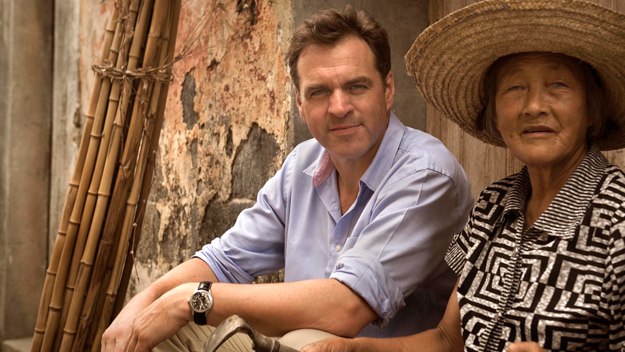
Niall Ferguson China Triumph and Turmoil


EPISODE 1: Niall Ferguson shows how the vast apparatus of the Chinese state has always been called on to subjugate individual freedom to the higher goal of unity. Ferguson also examines how, on the other hand, centralised control produces tensions that threaten to destroy the country.

EPISODE 2: Niall Ferguson asks how China manages to live under a Communist system of government but with a thriving capitalist economy. 

The succession of revolutions orchestrated by Mao Zedong killed more people than Hitler and Stalin combined. And yet this hard-line communist and murderer of businessmen is revered in China today as the founder of a modern-day capitalist superpower. Why?

To answer this question Niall travels from Beijing to Mao's birthplace at Shaoshan to the new supercity of Chongqing and to the rural backwaters of Anhui to track down survivors of the madness of Chairman Mao, newly minted billionaires and the Mao worshippers who believe tomorrow belongs to them. He finds the way China is governed is eerily similar to the way it was under the First Emperor. All the power lies in the hands of nine men with expressionless faces and what looks like the same hair dye - as unelected and as powerful as Emperor Qin. Autocracy that values unity over choice; secrecy over openness - not democracy. That has always been the Chinese way. It is the price that China is prepared to pay for the spectre that has always haunted its leaders: protest, rebellion and turmoil.

Episode 3: Niall Ferguson asks what China's growing global presence and aggressive nationalism mean to all of us.

Niall Ferguson China: Triumph and Turmoil Channel 4 8pm Monday 12th March
WATCH Episode 1 HERE
Watch Episode 2 HERE 
Watch Episode 3 HERE

Wednesday, 7 March 2012

Gok Wan Made in China

 China is a manufacturing colossus. Britons are surrounded by products sporting the legend 'Made in China'.

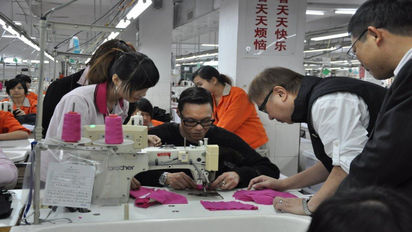
Gok Wan returns to his ancestral home to explore the largely unseen world of Chinese mass production, meeting the people working in the factories that supply the West.

He visits the village his father grew up in for the first time as part of a journey of discovery round a country that now produces one in every four man-made objects on the planet.

Gok goes to 'Jeans Town', 'Bra Town', the factory that makes London cabs, and 'Thames Town', as well as to ultra-modern Shanghai, where he meets a stylist pushing the boundaries in Chinese fashion.

Gok Wan Made In China Channel 4 8pm Wednesday 7th March 2012

Not content with calling Chinese 'Chinks' - CLICK HERE , if you missed his latest programme where the bumbling buffoon Gok Wan calls Chinese People 'Chinaman,' whilst his father calls himself yellow - WATCH IT HERE: http://www.channel4.com/programmes/gok-wan-made-in-china/4od#3298240

Sunday, 5 February 2012

Hong Konger or Chinese?

Full article REUTERS


As Hong Kong's outgoing leader Donald Tsang looks ahead to retirement, grassroots resentment has boiled over towards the influx of mainland Chinese visitors on a number of fronts, including healthcare and housing, presenting a twilight challenge for Tsang and his government's legacy of symbiotic integration with China. Twenty-eight million mainland Chinese visited Hong Kong last year, around four times the population of the city, many flush with cash and on the hunt for everything from baby formula to hospital beds and luxury brands to high-end apartments. Cross-border marriages have proliferated and Beijing's leaders have bestowed countless economic sweeteners on the city to cement the mainland's embrace of Hong Kong.

Insults are being hurled across the border, with some Hong Kongers decrying the mainland Chinese as "locusts," while one Chinese professor called Hong Kong people "running dogs" of the British.

FLOOD OF CHINA BABIES

One of the most controversial issues has been that of mainland Chinese mothers flocking to Hong Kong hospitals to give birth, partly to circumvent China's one-child policy and also to gain the right of abode in one of China's most developed and wealthiest cities. A broad provision in Hong Kong's mini-constitution, the Basic Law, grants Hong Kong citizenship to any Chinese born here.

In 2010, of the 88,584 newborns in Hong Kong, around a third, or 32,653 were born to mainland women, up from 620 babies in 2001. The influx has spawned an entire industry of agents shuttling Chinese mothers en masse across the border, hiding them in illegal 'inns' before birth.


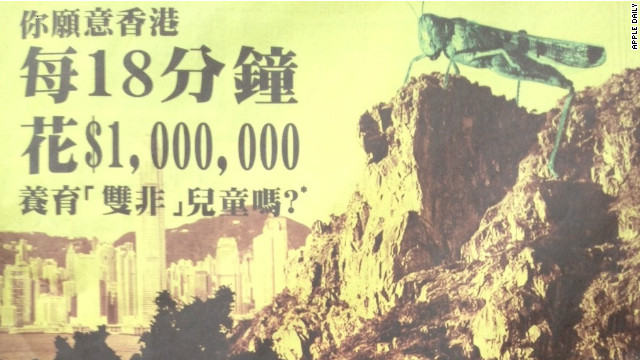
This week, a group of aggrieved Hong Kongers placed an incendiary front-page advertisement in the city's populist, mass circulation Apple Daily newspaper, denouncing Chinese women for crowding out Hong Kong's hospitals to the extent that maternity wards are booked solid until September.

"Hong Kong people have had enough!"
The ad proclaimed in large Chinese characters beside a picture of a giant locust on a hill overlooking Hong Kong's skyscrapers and iconic harbour. "Stop the invasion of mainland mothers" it added.

On the other side of the argument, there are signs that more and more mainland Chinese are becoming weary of Hong Kong's favoured status...

"If it wasn't the mainland Chinese treating you like a son, you would have died long ago," a retaliatory advertisement, widely circulated on mainland Chinese microblogging sites in response to the locust slurs.

HONG KONGER OR CHINESE

A confluence of other incidents and issues has also stoked debate, protests and frustration. Many Hong Kongers blame wealthy mainland Chinese for driving property prices beyond the reach of local citizens. Mainland Chinese snapped up around a third of residential flats last year, according to Nomura research, and home prices have risen as much as 70 percent since 2009.

Last year, mainland mothers, spooked by China's toxic melamine milk powder scare, bought up massive stocks of tinned milk powder from Hong Kong stores, leaving bare shelves and anxious Hong Kong mothers scouring shops citywide for formula.


The gripes found another lightning rod last month when a heated argument between a Hong Kong man who castigated a mainland Chinese visitor and her daughter on the city's subway for eating a bowl of noodles, went viral on YouTube.

The feud spurred a Peking University professor, Kong Qingdong, to call Hong Kong people "dogs" for their cultural superiority. His comments incensed many in Hong Kong and triggered a media backlash as well as protests outside China's Hong Kong liaison office.


Results from one of Hong Kong's most respected public opinion surveys suggested growing resentment towards mainland China. A December poll on the extent to which Hong Kongers identified themselves as Chinese citizens first or as a Hong Konger first dropped to 17 percent, the lowest level in 12 years.
                                                             -------------------------------

Excellent Blog covering the latest Hongkonger v Mainland issues http://badcanto.wordpress.com/tag/china/

Friday, 20 January 2012

Mainland Chinese Televsion: Hongkonger are dogs


 The above video speaks for itself - its the age old antagonism between HK and China, this time presented by a mainland professor.

However when it comes down to BBCS and Chinese in the UK, despite sharing the same country, UK, the non-communication /differentiation still exists.

Then here is an interesting comment i found on this article


Her response is  in bold italic, and in response to a previous anonymous poster and the discussion is whether the CCP are contributing towards the IR of our culture.


Assuming she is new to this country, Chinese, and female, and presumably a mainlander as opposed to HK Chinese, here is what she says:.
anonymous 3 January 2012 01:24 writes:

Allowing more female Chinese students abroad (65-35 according to a British survey on unis and foreign student intake - China was the only country with majority female);

That's nothing to do with the Chinese politics and governments, that is highly depend on the uk universities and whether the uk governments are willing to send out the visa or not. so in your opinion, what should the government do? forbid female to study abord?

allowing Chinese women to leave China as soon as a white man wants to marry her and "take her back";
it's same for man. if a Chinese man marry a western woman he of course can leave China too. and i think the policy applied in other countries like US as well.

allowing billboards and media to have mixed race/white man-chinese woman appearances as if it were the norm;

well, you should definitely watch taiwan and japan tv show. as a matter of fact, i can't even think of one mixed race celebrity that is based/famous in China now. where did you get the idea that it was 'the norm'?

allowing mail order bride "services" to operate in China;

never heard of that

allowing unwanted Chinese girls to be adopted by foreigners, who will adapt a white surname and become "white" in upbringing

so what should the government do? forbid female to be adopted by westerns? and from what i know the orphan can only be adopted by foreigners if no chinese family/individuals want to take over.

and the people you talked about is less than 1% of the total Chinese population (i guess), how the fuck will these 1% chinese damage Chinese race or demographics? and why 'race' matters to you anyway? japan has lots of mixed raced people and full of westerns, and i don't think there're anything wrong with it.


Today mainlanders increasingly emigrate to the UK, a better life, not unlike the previous commonwealth generation.

But why is there still antagonism between BBCs and mainlanders that spills over into the UK? Isnt the debate in the video suggesting that one is less Chinese than the other when the real truth is that both have sold out their chinese cultural pride for western hi-culture?

Here is another comment i found from a commentor on the topic of Chinese culture


anonymous 13 December 2011 04:02 writes:

The problem is that white influences are so intrinsic in the world today, it is impossible to do without being "restrictive", which the kids are only too aware of nowadays. Back when China was actually a world leader and the whites were still fighting each other for fun, Chinese culture simply did not have enough influence to affect white countries' own... it was seen as distinct and recognised, sure... but kept seperate from the native white cultures.

Of course there was no internet, media back then. Children were taught by the teacher and their parents alone, no-one else. The time to create a race's own unique brand identity is over, because mass modern media will no doubt "make it white" by default

So if we are to assume the above comment is true, what is the answer?

Culturally it wont make a difference whether you are a BBC who lives in the UK or a BBC or FOB who lives in China... if Chinese culture is not moving forward, it's preservation can only be renewed by the constant arrival of more FOBS to the UK, but never developed, especially if BBC'ers maintain the rift between HK chinese and mainland Chinese.

There has been suggestions that Chinese culture 'sold out' a long time ago, and it can be argued that the selling out of mainlanders is an inevitability.

So what does this have to do with overseas Chinese or British Born Chinese?

BBCS are in the perfect position to be ambassadors of Chinese culture? Why?

Because we know what its like to be demonised as being 'different' and the realities of not being accepted into mainstream ....and rather than taking the divide and conquer that is demonstrated in the video, in the UK, we British Chinese / all Chinese in Britain should work together.


If we know our culture is at its best being preserved by renewal of immigrants, despite the constant demonisation
and perversion of Chinese culture by elites, shouldn't mainland FOBS and commonwealth BBCS look to set aside our differences and start to work together ?

Friday, 6 January 2012

British Born Chinese in Beijing Part 4

British Born Chinese Trip to North and South of China Part 4

George Clooney, Modernisation and Chinese Culture

Having experienced Guangzhou's development, my last week back in Beijing opened my eyes to modernisation. I visited an exhibition of new and up and coming artists. Here I felt artists were experiencing a forced cultural transition from 'old'ie traditional Beijing culture to 'extremely new' and finding unease.


  People of china sucking from the teat of the communist cow.
Artificial future that could collapse like a tunnel of plastic chairs ?

In a western style cafe I met a young 20ish Beijing female artist and the topic landed on Chinese culture. When asking her about what the government are doing to promote Chinese culture, she told me ' I don't even think the government themselves know what Chinese culture is.' I took a look at her work she showed me on her ipad - all western artist influenced. A naked woman being sexually devoured by an octopus with penis like tentacles. I asked her where she was going to study next, and she revealed she was eager to go New York to Study Sculpture. I could only nod in sad agreement thinking 'we've lost another one'.

White Minorities

It's not such a major issue but what I did notice was the amount of white people at one of the exhibitions, ironically the Summer Palace, which was besieged several times and burnt down by westerners, and a considerable amount of tourists.


Hows it feel to be the 'minority' now ?

 'Read: where the allies invaded...'

Read:'destroyed by Anglo French Allied forces...'


White Guy/ Chinese Girl Couples

Several times, amazingly in Summer Palace and at the Forbidden City, two places that were besieged by allied imperialists, I saw these Chinese girl White guy pairings, and some white guy taking photos of his Chinese friends, who amazingly were all female.

It didn't help that my mainlander friend is unhealthily fascinated with white people, and so in a tourist resort full of Chinese, I somehow found myself surrounded by white tourists.

White Advertising

The big 12 X 18ft George Clooney watch poster in Wang Fu Jing shopping district, and the interracial ad with GC and a Chinese girl on TV didn't exactly help my wishes of wanting to see a less white worshipping China, and nor did this George Clooney commercial which was doing the rounds on Chinese TV at the time:


And if there's any compensation, I did actually see a white skin cream bus poster next to an energy drink with a pic of a Black man. So maybe Beijing is focusing on international relations. Sorry I don't have pics of these, you'll just to have to believe me.

On the whole, Beijing with it's TV, tries to emulate the US with its new found 'freedom'. The intro to the tennis opening, noticeably showed only white sports players, and indeed most of the participants were white (Polish etc ) but there were Chinese players - so why no Chinese players on the opening program intro?

Winner: Modernisation or westernisation?

My thoughts during my second week were mixed. On one hand it's clear that people are happier, but at the same time whilst the younger generation are on the way to and from work, the more affluent older generation are just grateful for what the government has done.


 Millionaire hutong owners

For most however, from the street peddlers selling bracelets, hats, and all kinds of trinkets just to make a living, to the taxi driver who took me from the railway station to the hotel who I just sensed had a pretty tough life... I can't help but feel a sense of emotional disparity. Its feint, but its noticeable. Like I said before, It's a great place, but being culturally sensitive to my fellow Chinese, I feel that only those who can afford to stay, stay in Beijing and those who cannot, despite having residence here are forced to become homeless or struggle to maintain their new standard of living.

Historically China's whiteworshipping can be seen as a case of Chicken or Egg. Sun Yat Sen fought for modernisation but now CCP seems desperate to westernise, but in reality whatever cultural offering they have from 'investing in innovation' to ' making museums free' to 'building another cultural centre' ends up in mass disinterest. Bit watching like a senior citizen learn how to breakdance. You know he wants to show you he can, but he's 50 years too late and its painful to watch.

Bottom line: unless the people have real freedom and not the illusion of freedom, culture will continue to embarrass.

I have heard some things about Shanghai, which I havent visited yet, so I will reserve judgement for when I visit, but in comparing Beijing and Guangzhou, I'd say Beijing is more apparent in it's whiteworshipping maybe because it's much younger in it's adoption of modernisation.
 
Despite demonisation by the west, we BBC'ers are still lucky to still have such a great motherland, which is more than I can say for the other countries that have been pillaged by Imperialists.

But regardless of modernisation, as a BBC and a  Chinese ethnic 'minority' in the west,  I'm grateful for having a homeland that is thriving and growing. Just a shame that when I arrived back home I got withdrawal symptoms for at least a week and a half . But that's the way it is. Can't wait til my next trip out there again.


Wednesday, 28 December 2011

Old Man Young Girl

By BBCZeitgeist in Asia

Hong Kong's favourite bin tai lo - Edison Chen, his latest escapade is 16 yr old teenage Chinese model Cammi Tse, difference in age of 15 years. Story Here

Not to be outdone by these leisurely celebrities... whilst I was standing in a taxi queue at a popular getaway resort, an older Chinese male aged 50-55 and a younger Chinese female aged 18-22 stood in front. 

Its a holiday break, time for father and daughter to spend some quality family time together?  

 Signs of public affection ...

 Not father and daughter! A possible 37 years dating age difference?

Friday, 23 December 2011

British Born Chinese trip to North and South of China - Part 3

Part 3

Guangzhou, Opium Museum and Sun Yat Sen Memorial Hall


 Different countries paying tribute to Sun Yat Sen at the time of his death

From trying to hold my trainers above water trudging through the sudden flash flooded streets at midnight back to our hotel to getting mobbed by beggars,   Guangzhou was the most memorable part of my trip to China.
During my first few days there, the weather was not what I was used to in Beijing. Hot during the day outside,  damp and humid at night indoors.. took some getting used to.

Language was still a problem especially as my Canto is rusty and my mainlander friend doesnt speak any Cantonese. But we both managed to get by.

In Guangzhou the best experiences are the buses. They say foreigners dont like to travel on the buses - maybe I was only there for a few days but I  didnt mind the crowding and shoving too much.

View from front of Guangzhou bus pic 1
If i cant always express my respect for elders through language, I'll do it by way of manners. But I can see how people can get aggravated by the pushing and shoving on a regular basis, I guess the trick is to just show some courtesy. And in some cases, it worked - when people are defensive, you just do the opposite and they usually appreciate the gesture.


View from front of Guangzhou bus pic 2

So...Opium War Museum. Here are some pics I took. Again, flash photography was forbidden, and all I had was a flash camera which I had to sneak inside. Either way it was an interesting experience learning about  how Guangzhou mainly shipped and exported goods to and from China, cotton, silk. tea. before the Brits arrived and drugged everyone.


 Roughly translates into  'Guangzhou will never forget disaster of Opium War'


The original Xin Hai revolutionary Sun Yat Sen whose goal was to modernise China, his revolution however was short lived as he was eventually betrayed by the Qing dynasty president Yuan Shikai  (who played an important role in toppling Qing government) who disbanded the assembly and attempted to revive the monarchy. , But as this attempt failed,   China fell from grace as the Japanese invasion carried on up to the civil war until the founding of the People's Republic of China  and then the Communists couldnt collaborate with Chiang Kai Shek who wanted capitalism and fled to Taiwan.

 So what had I learnt here?Mainly that China has a frail spotted past - frail in that there wasnt the right collaboration between powers ... and  'spotted' because of two contraversial figures - Mao and Chiang Kai Shek, so that any achievements were often undermined by tragedy.

Although Mao united China, for the last 20 years - or the cultural revolution - he went power mad.

If it wasnt for his extra 20 years reign, China would arguably be 20 years more advanced by now and if Deng Shiao Ping ruled earlier it wouldve been capitalist faster but as it is, it took much longer.
Infighting egos and lack of foresight destroyed the China empire amaking it an easier target for western subterfuge.

So what about Guangzhou today? Well in the mass of cheap luxury goods, and crowds spewing around the Beijing Roads,  cramming on buses, nobility and self-discipline isn't so evident.

But in the park  Tai Chi and Tai Chi broadsword, - the last remnants of our culture is still being practiced daily by the older gen.

 Practicing TaiChi broadsword  in Guangdong Cemetary

Also some kids playing kicking the shuttlecock or Jiànzi with relatives/family with amazing accuracy.

Whilst the culture long established in Guangzhou is one of materialism,  the Guangzhou Prayer Temple was an odd combination - of commerce and spirituality.


 Preparing Incense for prayer

Before entering the temple, a shaved headed man dressed as a monk came up to me with a small square piece of cloth with a gold plastic temple emblem attached to it, stuffed it into my pocket and immediately whipped out a notepad , asking me to sign away 1000rmb.

I didnt like his attitude when he kept badgering me - I couldnt believe I was actually negotiating with him how much I wanted to offer. Anyway I finally got him down to 200rmb, gave him the money and he quickly pissed off looking for his next victim.

But as you can imagine that put me off offering to help any other beggars and yes outside the temple there they were - begging cups outreached,  disfigured, no arms, legs ...waiting for unsuspecting tourists...this was their living. Like some circus show.

Things got even worse when I went with my friend to a nearby park and I gave some money to an odd couple of performers - from nowhere this toothless old Chinese woman grabbed my arm and started shoving a tin in my face. And my friend was nowhere to be seen. Luckily I saw two police opposite under some trees and dashed across the street without getting killed by speeding bicycles and stood there next to them. Amazingly the woman vanished.  It was time to go home.

 If anything these are a pragmatic people concerned with survival, sleeping behind shopcounters on slow days when no customers,  the bustle of everyday life.

 Shopping in Beijing Road

But despite the sometimes tense edgy attitude on the hot days,most of the time it felt good to blend in, and once enjoying not being noticed to be an 'minority' as in the west. 

At night in particular, walking on the riverside at night was peaceful experience...despite having to run to the toilet all the time because I had severe shits due to the different bacteria that food in China has.


Riverside in commercial district of Guangzhou
People playing Chinese chess near the riverside, couples walking /biking past and some guy expertly catching with a huge net drew a huge crowd  over, were the nicer memories.

But after possibly overstaying longer than I should've done, especially with a grumpy Hunan roomate who disliked Guangzhou, we survived a week together without killing each other and finally it was time to leave.

Maybe Beijing which has recently opened up has a very young modern culture, and still has a future ahead of it, Guangdong in contrast is money, materialism, and technology, and general all round contentment with this existance therefore little need to express it.

There weren't too many people visiting the Opium Museum, on the day that I went,  but the crowd was fairly busy for the Sun Yat Sen Memorial Hall, maybe because of celebrating 100th anniversay of the Xinhai revolution...
Maybe it's a fair assumption to say Guangzhou-ers tend to care less for history of fighting for China's liberation from Qing Dynasty than the benefits of modernisation from the west that Sun Yat Sen's victory brought them. Hopefully Beijing , with it being the new cultural centre of China can learn from this,ie retaining its culture instead of blatantly accepting westernisation only time will tell.


Sun yat Sens statue outside his Memorial Hall

I really don't think I could live here in Guangzhou -  and staying here for long periods with the extreme opposites of weather heat and humidity would probably just do my head  in.


Beijing Road in Guangzhou

To top it off, all I dropped my UK mobile in the toilet visiting the Opium Museum. yes, those famous stoop your arse over the hole in the ground toilets that they had on the train here and it seems in most public places. And to top that, I had to wipe my arse with a herbal teabag I found in my travel pouch.
No idea why they don't have any toilet paper or soap in the Opium Museum but from that moment on, I learnt my lesson and from then on decided to  pack my own supplies.

At least I had my roommate's spare phone for the rest of the trip.

Anyone else have strange experiences travelling in China/Guangzhou?